Whether or not Barack Obama was your choice in this past election, it’s clear changes are in the making. Major news organizations report possible reversals of current policies on stem cell research and drilling. Speculation on posts in his administration during the transition and afterward circle the Beltway in typical DC fashion, driving you wild or serving as a major source of entertainment.
I’m most eager to see if Obama will go with the recommendation made in letters to then-Presidential candidates Obama and McCain in October. These letters called for the speedy post-election appointment of a newly-created “Assistant to the President for Science and Technology” as a cabinet-level position. The signatories included a broad range of science- and math-related institutions such as the American Association for the Advancement of Science and the National Center for Science Education. They referenced both candidates' responses to the Science Debate 2008 questions as reflecting their “acknowledgment of the important role that science will play in a new Administration,” and went on to point out that, “it is essential to quickly appoint a science advisor who is a nationally respected leader with the appropriate scientific, management and policy skills necessary for this critically important role.”(1)
The Woodrow Wilson International Center for Scholars released a similar recommendation along with their OSTP 2.0 report back in June. (2) That report cited the importance of expert advice in the evaluation and shaping of the $142 billion investments in science and technology the US will need to make. It also pointed out that, “Science and technology pervade virtually all domestic and global issues. The defining policy issues facing our nation are directly related to our capabilities in science, technology, and innovation. Those issues span national security and economic competitiveness, energy security, environmental protection and natural resource conservation, public health, and quality of life.”
As “Key Issues Facing the OSTP” they cited environmental and energy challenges, enhancing US global leadership in innovation, responding to national security challenges, the need for improved S&T education at all levels, improving health and health care delivery, and ensuring greater public understanding of scientific issues and advances. (3) It’s certainly hard to question any of these.
Whether or not Obama goes with the recommendation remains to be seen, but with nearly 180 respected signatories on the letter and every living former Science Advisor contributing to the Wilson report, it’s certainly worthy of his serious consideration.
(1) Letter to then-Senator Barack Obama
(2) Woodrow Wilson International Center for Scholars OSTP 2.0 Critical Upgrade Report
(3) Woodrow Wilson International Center for Scholars OSTP 2.0 Critical Upgrade Report
Tuesday, November 11, 2008


Tuesday, October 28, 2008
Boo!
 It's the time of year for reflections on the fleeting nature of things and all sorts of other deep thoughts. Here in New England, the maple trees briefly – so briefly – flash their stunning incandescent red and orange leaves. Then, of course, the trees shed the leaves on my lawn, where they need to be raked up – a chore that is not at all fleeting.
It's also Halloween, which has a special place in the hearts of the Witches of Agnesi. So, here are a couple of Halloween-relevant legends.
Razors in Apples: Urban Legend
In their book Made to Stick: Why Some Ideas Survive and Others Die, Chip Heath and Dan Heath offer some fascinating explanations for why some excellent ideas – say, an earnest mission statement from a worthwhile nonprofit organization – get little traction, while some patently ridiculous urban legends are believed and repeated by millions of people.
The Heath brothers give the example of a wildly “successful” idea that spoiled Halloween for large numbers of people: the belief that evil strangers were putting razor blades and poison in apples and candy and giving them to trick-or-treating children. But in 1985, researchers Joel Best and Gerald Horiuchi
“studied every reported Halloween incident since 1958. They found no instances where strangers caused children life-threatening harm on Halloween by tampering with their candy. Two children did die on Halloween, but their deaths weren't caused by strangers. A five-year-old boy found his uncle's heroin stash and overdosed. His relatives initially tried to cover their tracks by sprinkling heroin on his candy. In another case, a father, hoping to collect on an insurance settlement, caused the death of his own son by contaminating his candy with cyanide. In other words, the best social science evidence reveals that taking candy from strangers is perfectly OK. It's your family you should worry about.
"The candy-tampering story has changed the behavior of millions of parents over the past thirty years.... It has even changed the laws of this country. Both California and New Jersey passed laws that carry special penalties for candy-tamperers. Why was this idea so successful?"
To find out, read the book.
The Devil's Chord
Can a musical chord be evil? The Medieval Roman Catholic Church and modern heavy metal bands think so. The tritone, "a musical interval that spans three whole tones, like the diminished fifth or augmented fourth.... the gap between two notes played in succession or simultaneously, was branded Diabolus in Musica or the Devil's Interval by medieval musicians. A rich mythology has grown up around it. Many believe that the Church wanted to eradicate the sounds from its music because it invoked sexual feelings, or that it was genuinely the work of the Devil. It is a mythology much beloved of long-haired guitar wizards. In the newly-released documentary Metal: A Headbanger's Journey, bassist Alex Webster of death metal act Cannibal Corpse pays tribute to the effect of the forbidden "Devil's note" on heavy metal" (Finlo Rohrer, 2006).
According to Wikipedia,
"Today the interval continues to suggest an 'oppressive,' 'scary,' or 'evil' sound. However, suggestions that singers were excommunicated or otherwise punished by the Church for invoking this interval are likely fanciful."
Examples of music using tritones:
Jimi Hendrix, Purple Haze
Danny Elfman, The Simpsons theme song
"Maria," from Leonard Bernstein's West Side Story
Black Sabbath, "Black Sabbath"
Claude Debussy, Prelude to the Afternoon of a Faun
Richard Wagner, Gotterdammerung
References
Heath, Chip, and Dan Heath. 2007. Made to Stick: Why Some Ideas Survive and Others Die. New York: Random House (pp. 13–15). www.amazon.com/Made-Stick-Ideas-Survive-Others/dp/1400064287
Rohrer, Finlo. 2006. "The Devil's Music," BBC News Magazine (April 4), http://news.bbc.co.uk/go/pr/fr/-/2/hi/uk_news/magazine/4952646.stm
"Tritone," Wikipedia, http://en.wikipedia.org/wiki/Tritone
Sunday, October 19, 2008
Primordial Sludge
One of the enduring imaginative musings of my childhood is of a bolt of lightning striking a shallow pool of water. More like an indention in a rock, really, with a bit of rainwater barely deep enough to keep the mini-pond wet. As the lightning hits, it vaporizes the water and voila! Primordial sludge forms. Fast forward a couple of months and actual creatures – microscopic but creatures nonetheless – are wriggling out of the somehow still wet spot on the rock. Oh. Must have been a spring supplying the water. And there must have been a bit of shade so the microscopic creatures didn’t fry in the noonday sun. And there must have been some source of nutrients. But what did I know at six? And despite my youngest child’s current confusion, I wasn’t actually there at the moment that lightning bolt hit.
So imagine my delight to see in Science this week that someone actually did an experiment to see what would happen when lightning struck the presumed early building blocks of life on Earth. Yes. Back in the early 1950’s. Two chemists at the University of Chicago in Illinois, Miller and Urey, introduced an electric current to a mixture of gases and water in a closed loop of glass. When they analyzed the material that collected after a few hours, they discovered about 10 amino acids. BUT recent experiments on that same residue with an extremely sensitive mass spectrometer at NASA’s Goddard Space Flight Center in Greenbelt, MD revealed all 20 of the amino acids in things living today. Not bad. So now they’re wondering: 1) Could a volcano have started it all, and 2) How did this material – my fondly remembered primordial sludge – turn into “self-replicating organic compounds?” That’s the matter (no pun intended) now before geochemists Jim Cleaves and Jeffrey Bada.
I’m looking forward to seeing what they discover!
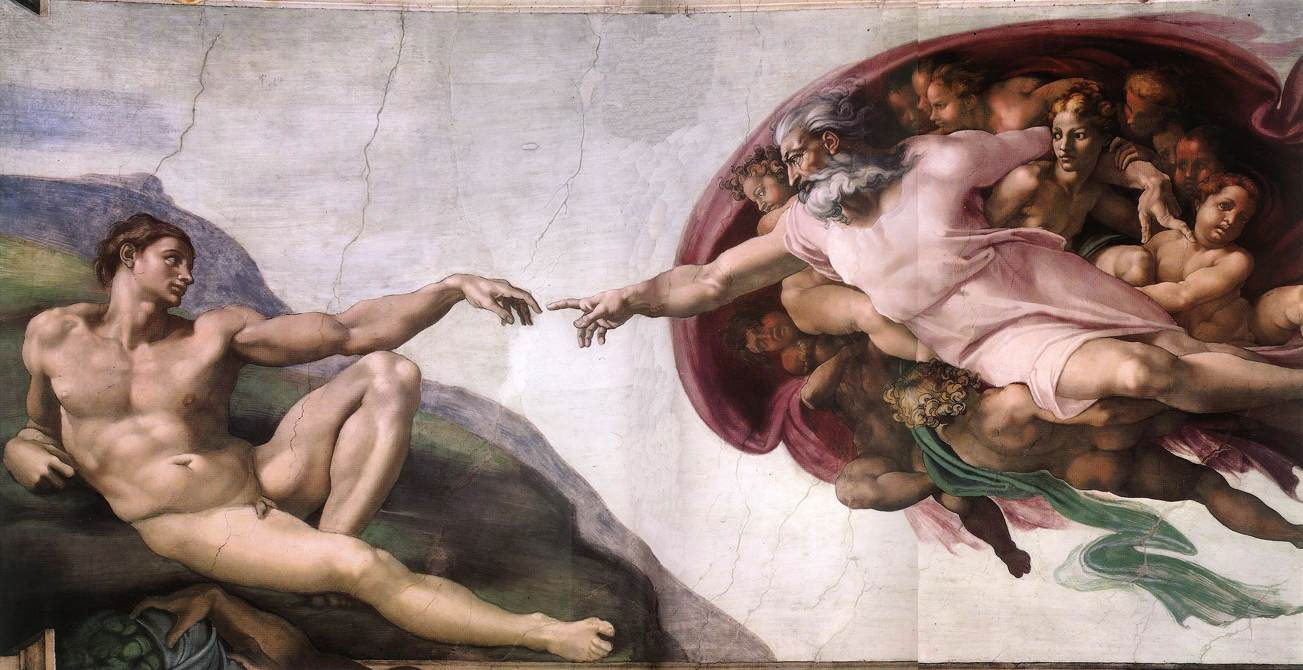
... Of course that still leaves the matter of the Creation of Adam on the ceiling of the Sistine Chapel. Forever linked in my mind with that lightning bolt and the sludge, there's no electric charge in evidence. But I've always been certain that Michelangelo has one implied. And that his imaginative musings were far more fully evolved than mine!
Source: http://sciencenow.sciencemag.org/cgi/content/full/2008/1016/1
So imagine my delight to see in Science this week that someone actually did an experiment to see what would happen when lightning struck the presumed early building blocks of life on Earth. Yes. Back in the early 1950’s. Two chemists at the University of Chicago in Illinois, Miller and Urey, introduced an electric current to a mixture of gases and water in a closed loop of glass. When they analyzed the material that collected after a few hours, they discovered about 10 amino acids. BUT recent experiments on that same residue with an extremely sensitive mass spectrometer at NASA’s Goddard Space Flight Center in Greenbelt, MD revealed all 20 of the amino acids in things living today. Not bad. So now they’re wondering: 1) Could a volcano have started it all, and 2) How did this material – my fondly remembered primordial sludge – turn into “self-replicating organic compounds?” That’s the matter (no pun intended) now before geochemists Jim Cleaves and Jeffrey Bada.
I’m looking forward to seeing what they discover!
... Of course that still leaves the matter of the Creation of Adam on the ceiling of the Sistine Chapel. Forever linked in my mind with that lightning bolt and the sludge, there's no electric charge in evidence. But I've always been certain that Michelangelo has one implied. And that his imaginative musings were far more fully evolved than mine!
Source: http://sciencenow.sciencemag.org/cgi/content/full/2008/1016/1
Monday, October 13, 2008
Identity Crisis
Americans are uniquely concerned with individuality, independence, and personal identity. Ads, self-help gurus, pop culture entertainment, and political and economic conventional wisdom bombard us with messages about self-expression and individual identity. But research shows that there is a powerful social, collective element to identity, too.
Psychologist John Cacioppo and science writer William Patrick (2008) cite Wendy Gardner and Marilyn Brewer, whose research found that answers to the question, “who are you?” fell in three categories: personal, intimate; social, relational (spouse, kids, friends, neighbors); and collective (ethnic group, nation, profession, sports team) (p. 78). Cacioppo and Patrick’s goal is to “change our culture’s lopsided view of human nature, its focus on the individual in isolation as the proper measure of all things” (p. 19).
In our single-minded focus on individual identity, we may be neglecting to demand policies that strengthen our social and civic identities. Consider our voting system. Practices such as “caging” cause the identity and eligibility of many citizens to be challenged at polling places for questionable reasons. The Michigan Messenger (Brayton 2008) reported that the Democratic Party recently filed a lawsuit in Michigan to prevent lists of foreclosures – disproportionately involving African Americans – from being used to challenge voters’ addresses of residence. The standards of accuracy and fairness of lists like these – techniques borrowed from direct mail – are inadequate to be used to determine citizens’ rights. The lists contain errors; people are mistaken for people with similar names; and many people who have had foreclosure proceedings initiated still live in their houses or are still entitled to count them as a legal residence. Elsewhere, inaccurate lists of convicted felons have also been used in this way.
A different system prioritizing citizens’ rights might address some of these problems – for instance, the use of a national identification card. The thought of a nationally centralized database controlled by the federal government with personal identification information about every citizen from birth to death raises the hair on the backs of many necks, from libertarians and populist conservatives to liberals and privacy advocates – and rightly so. But a democracy that purports to represent the will of any group bigger than a village in which everyone knows each other – let alone millions of people spread across a geographic area of 3,794,066 square miles – must have a reliable way of establishing accurate identities of citizens eligible to vote. We fear giving too much power to “big government.” But the government, marketers, credit bureaus, health-insurance providers, financial institutions, credit card companies, retail stores, and Internet-based services already collect, buy, and sell our personal data – in many cases, without our knowledge and with little concern for our privacy.
This has implications for our system of voting. Progressive political commentator Robert Kuttner (2004) argued:
“Tens of millions of Americans don't vote because we make voters go through a two-step process of registering and then voting. As we saw in the elections of 2000 and 2004, the registration process is an invitation to endless political mischief. In fact, registration was introduced in the late 19th century precisely to hold down the numbers of votes, from former slaves and from recent immigrants. It still functions to hold down voting today. In most countries, the national ID card certifies your identity, age, and citizenship. That's it. You present the card, and you vote. In America, millions of volunteer hours and hundreds of millions of dollars go into the needless process of registering voters – time and money that could go toward political activism and education.”
Our unplanned approach to legitimate identification needs has led to a hodgepodge of identification policies that neither provide accurate identification nor protect the privacy of citizens. The REAL ID Act of 2005 was an attempt by the Department of Homeland Security to turn state drivers’ licenses into a quasi-national ID card whose purpose would be to establish identity when the holder boarded a commercial aircraft or entered a federal building or other federal property. States protested that it was an unfunded mandate that would cost them billions of dollars and require departments of motor vehicles to assume immigration and policing functions they weren’t designed for; implementation, originally scheduled for May 2008, was postponed until 2017, and many states have vowed they will never agree to it. The social security card, another common proxy for a national identification card, is also inadequate for that purpose – it’s easily falsified and vulnerable to identity theft. (Sources: EPIC 2008; Gaouette & Mathews 2007; McLaughlin 2007; NCSL 2008)
According to Esther Dyson (2008) in a recent Scientific American article, there’s no going back to the pre-computer days. The issue is not so much increasing privacy for individuals, she argues, but limiting privacy for institutions, so we can monitor what they’re doing with the data they’re collecting. She also points out that many issues that look like privacy issues are actually the result of inadequate policies in other areas. For instance, privacy of genetic information and medical records would not be such an issue if we had universal health coverage and health insurers did not have the power to cherry-pick healthier individuals.
What if U.S. elections looked like elections in many other countries? All U.S. citizens would be presented with a national identification card, free, at birth, which would accompany them throughout life. The cards would feature the secure technology used in most countries for identification – in contrast to driver’s licenses now available in Arizona and some other border states that have inexpensive EPCglobal Gen2 technology like that used for E-Z passes, designed to track products in warehouses, which can be easily captured through walls and purses by readers available in virtually any warehouse in the country (Albrecht 2008). To vote, citizens would present their national identification card – doing away with the contentious and expensive voter registration process. Elections would be held on weekends, or election day would be a national holiday, so they wouldn’t compete with work. And in a real shift for the U.S., voting would be mandatory – a right and responsibility of all citizens, rather than one more consumer choice. How different would our election results be?
References
Albrecht, Katherine. 2008. “RIFD tag – You’re it,” Scientific American 299, no. 3 (September).
Brayton, Ed. 2008. “Obama campaign files suit over ‘voter-foreclosure’ plans,” Michigan Messenger (September 16). http://michiganmessenger.com/4463/obama-campaign-files-suit-over-foreclosure-lists
Cacioppo, John T., and William Patrick. 2008. Loneliness: Human Nature and the Need for Social Connection. NY: W. W. Norton.
Dyson, Esther. 2008. “Reflections on privacy 2.0,” Scientific American 299, no. 3 (September).
Electronic Privacy Information Center. 2008. Real Id Implementation Review: Few Benefits, Staggering Costs (May). http://epic.org/privacy/id-cards/epic_realid_0508.pdf
Gaouette, Nicole, and Joe Mathews. 2007. “Illegal immigrant licenses drive debate,” Los Angeles Times (November 1). http://articles.latimes.com/2007/nov/01/nation/na-licenses1
Kuttner, Robert. 2004. “Try national ID card – you might like it,”
Boston Globe (December 8). http://www.boston.com/news/globe/editorial_opinion/oped/articles/2004/12/08/try_national_id_card____you_might_like_it/
McLaughlin, Eliott C. 2007. “Federal ID plan raises privacy concerns,” CNN.com (August 16). http://www.cnn.com/2007/POLITICS/08/16/real.id/index.html
National Conference of State Legislatures. 2008. Real ID news. NCSL.org http://www.ncsl.org/standcomm/sctran/Real_ID_news.htm
Psychologist John Cacioppo and science writer William Patrick (2008) cite Wendy Gardner and Marilyn Brewer, whose research found that answers to the question, “who are you?” fell in three categories: personal, intimate; social, relational (spouse, kids, friends, neighbors); and collective (ethnic group, nation, profession, sports team) (p. 78). Cacioppo and Patrick’s goal is to “change our culture’s lopsided view of human nature, its focus on the individual in isolation as the proper measure of all things” (p. 19).
In our single-minded focus on individual identity, we may be neglecting to demand policies that strengthen our social and civic identities. Consider our voting system. Practices such as “caging” cause the identity and eligibility of many citizens to be challenged at polling places for questionable reasons. The Michigan Messenger (Brayton 2008) reported that the Democratic Party recently filed a lawsuit in Michigan to prevent lists of foreclosures – disproportionately involving African Americans – from being used to challenge voters’ addresses of residence. The standards of accuracy and fairness of lists like these – techniques borrowed from direct mail – are inadequate to be used to determine citizens’ rights. The lists contain errors; people are mistaken for people with similar names; and many people who have had foreclosure proceedings initiated still live in their houses or are still entitled to count them as a legal residence. Elsewhere, inaccurate lists of convicted felons have also been used in this way.
A different system prioritizing citizens’ rights might address some of these problems – for instance, the use of a national identification card. The thought of a nationally centralized database controlled by the federal government with personal identification information about every citizen from birth to death raises the hair on the backs of many necks, from libertarians and populist conservatives to liberals and privacy advocates – and rightly so. But a democracy that purports to represent the will of any group bigger than a village in which everyone knows each other – let alone millions of people spread across a geographic area of 3,794,066 square miles – must have a reliable way of establishing accurate identities of citizens eligible to vote. We fear giving too much power to “big government.” But the government, marketers, credit bureaus, health-insurance providers, financial institutions, credit card companies, retail stores, and Internet-based services already collect, buy, and sell our personal data – in many cases, without our knowledge and with little concern for our privacy.
This has implications for our system of voting. Progressive political commentator Robert Kuttner (2004) argued:
“Tens of millions of Americans don't vote because we make voters go through a two-step process of registering and then voting. As we saw in the elections of 2000 and 2004, the registration process is an invitation to endless political mischief. In fact, registration was introduced in the late 19th century precisely to hold down the numbers of votes, from former slaves and from recent immigrants. It still functions to hold down voting today. In most countries, the national ID card certifies your identity, age, and citizenship. That's it. You present the card, and you vote. In America, millions of volunteer hours and hundreds of millions of dollars go into the needless process of registering voters – time and money that could go toward political activism and education.”
Our unplanned approach to legitimate identification needs has led to a hodgepodge of identification policies that neither provide accurate identification nor protect the privacy of citizens. The REAL ID Act of 2005 was an attempt by the Department of Homeland Security to turn state drivers’ licenses into a quasi-national ID card whose purpose would be to establish identity when the holder boarded a commercial aircraft or entered a federal building or other federal property. States protested that it was an unfunded mandate that would cost them billions of dollars and require departments of motor vehicles to assume immigration and policing functions they weren’t designed for; implementation, originally scheduled for May 2008, was postponed until 2017, and many states have vowed they will never agree to it. The social security card, another common proxy for a national identification card, is also inadequate for that purpose – it’s easily falsified and vulnerable to identity theft. (Sources: EPIC 2008; Gaouette & Mathews 2007; McLaughlin 2007; NCSL 2008)
According to Esther Dyson (2008) in a recent Scientific American article, there’s no going back to the pre-computer days. The issue is not so much increasing privacy for individuals, she argues, but limiting privacy for institutions, so we can monitor what they’re doing with the data they’re collecting. She also points out that many issues that look like privacy issues are actually the result of inadequate policies in other areas. For instance, privacy of genetic information and medical records would not be such an issue if we had universal health coverage and health insurers did not have the power to cherry-pick healthier individuals.
What if U.S. elections looked like elections in many other countries? All U.S. citizens would be presented with a national identification card, free, at birth, which would accompany them throughout life. The cards would feature the secure technology used in most countries for identification – in contrast to driver’s licenses now available in Arizona and some other border states that have inexpensive EPCglobal Gen2 technology like that used for E-Z passes, designed to track products in warehouses, which can be easily captured through walls and purses by readers available in virtually any warehouse in the country (Albrecht 2008). To vote, citizens would present their national identification card – doing away with the contentious and expensive voter registration process. Elections would be held on weekends, or election day would be a national holiday, so they wouldn’t compete with work. And in a real shift for the U.S., voting would be mandatory – a right and responsibility of all citizens, rather than one more consumer choice. How different would our election results be?
References
Albrecht, Katherine. 2008. “RIFD tag – You’re it,” Scientific American 299, no. 3 (September).
Brayton, Ed. 2008. “Obama campaign files suit over ‘voter-foreclosure’ plans,” Michigan Messenger (September 16). http://michiganmessenger.com/4463/obama-campaign-files-suit-over-foreclosure-lists
Cacioppo, John T., and William Patrick. 2008. Loneliness: Human Nature and the Need for Social Connection. NY: W. W. Norton.
Dyson, Esther. 2008. “Reflections on privacy 2.0,” Scientific American 299, no. 3 (September).
Electronic Privacy Information Center. 2008. Real Id Implementation Review: Few Benefits, Staggering Costs (May). http://epic.org/privacy/id-cards/epic_realid_0508.pdf
Gaouette, Nicole, and Joe Mathews. 2007. “Illegal immigrant licenses drive debate,” Los Angeles Times (November 1). http://articles.latimes.com/2007/nov/01/nation/na-licenses1
Kuttner, Robert. 2004. “Try national ID card – you might like it,”
Boston Globe (December 8). http://www.boston.com/news/globe/editorial_opinion/oped/articles/2004/12/08/try_national_id_card____you_might_like_it/
McLaughlin, Eliott C. 2007. “Federal ID plan raises privacy concerns,” CNN.com (August 16). http://www.cnn.com/2007/POLITICS/08/16/real.id/index.html
National Conference of State Legislatures. 2008. Real ID news. NCSL.org http://www.ncsl.org/standcomm/sctran/Real_ID_news.htm
Sunday, October 5, 2008
Aerodynamics of a Baseball in Flight
It's the MLB Postseason! As the days grow shorter and the leaves turn, how can anyone think of anything but baseball ...
Nine inches in circumference. Weighing in at about five ounces. Made of cork wound with woolen yarn covered with two layers of cowhide stitched by hand precisely two hundred sixteen times… Every baseball used in Major League play today is made to these specs.
Over the years there have been claims of juicing, concerns about the effects of altitude and humidity, and changes to the cork in 1910, the yarn in 1920, and a switch to cowhide from horsehide in 1974. But every ball has been manufactured to exact specifications since 1874. And every ball is still handstitched – currently at the Rawlings manufacturing facility in Costa Rica.
Nine inches in circumference. Weighing in at about five ounces. Made of cork wound with woolen yarn covered with two layers of cowhide stitched by hand precisely two hundred sixteen times… Every baseball used in Major League play today is made to these specs.
Over the years there have been claims of juicing, concerns about the effects of altitude and humidity, and changes to the cork in 1910, the yarn in 1920, and a switch to cowhide from horsehide in 1974. But every ball has been manufactured to exact specifications since 1874. And every ball is still handstitched – currently at the Rawlings manufacturing facility in Costa Rica.
The real news relating to the ball itself occurred in 1920 after Yankee pitcher Carl May’s fastball bounced off Cleveland Indians batter Ray Chapman’s skull with the resounding crack of a pitch well hit. Chapman reportedly took two steps toward first before dropping to the ground - skull crushed - to die twelve hours later.
Ever since, dirty, misshapen, barely discernible lumpy balls rushing toward the batter have been outlawed. Only spotless, flawless baseballs can remain in play. The designation of “flawless” isn’t left up to the perception of the batter or the pitcher. The umpire inspects each ball frequently. When he decides one is unfit, he puts a new one into play.
But a new baseball is a gleaming white orb of perfection that’s slick to the touch. The cowhide ensures that. For a pitcher to get a good grip, something has to be done to make the ball less glossy. Spit, nicks, gels — any tampering or foreign substance altering the appearance or aerodynamic properties of the ball is illegal. Something was needed that could make the ball uniformly easier to handle — without amending the ball in any way.
But a new baseball is a gleaming white orb of perfection that’s slick to the touch. The cowhide ensures that. For a pitcher to get a good grip, something has to be done to make the ball less glossy. Spit, nicks, gels — any tampering or foreign substance altering the appearance or aerodynamic properties of the ball is illegal. Something was needed that could make the ball uniformly easier to handle — without amending the ball in any way.
An ex-player and manager named Lena Blackburne was the one who solved the problem in the 1930’s with his discovery of the perfect mud. He harvested it from a still-secret location in New Jersey until his death. The location was passed on and this ‘magic mud’ that doesn’t discolor, soften, or stink up the ball has been rubbed on every ball in Major League play before every game ever since.
***
But any batter can tell you that seeing the ball and hitting the ball are two different things. It’s not enough to figure out the probable pitch racing toward you. You’ve got to get the bat in the precise position needed to connect solidly.
It’s a humbling experience and today with two balls, two outs, and men on first and second, there’s now as much pressure on the batter standing ready at the plate, as there has been on the pitcher all day.
On the mound, the pitcher nods at the catcher’s signal and makes the throw.
The batter steps into his swing. The crack of the bat reports a solid hit as the left fielder races to make the catch.
The batter steps into his swing. The crack of the bat reports a solid hit as the left fielder races to make the catch.
No one has control of the ball now.
Now that it’s airborne air temperature, the amount of moisture in the air, wind and wind direction all come into play. And that’s not all. The speed of the bat when it met the ball, the angle of the bat on the swing, where along the bat the ball was hit – all of these matter, too.
How much any of it matters has been the subject of much debate. So much so that in 1987 President of the National Baseball League, Bart Giamatti, named Dr. Robert K. Adair Physicist to the National League. Adair’s wonderful book, The Physics of Baseball, resulted. Its detailed scientific and conversational explanations cover the effect of factors ranging from the length of time a batter has to reach a decision on a pitch and what a pitcher can do to minimize that time, to the optimal weight of a bat.
How much any of it matters has been the subject of much debate. So much so that in 1987 President of the National Baseball League, Bart Giamatti, named Dr. Robert K. Adair Physicist to the National League. Adair’s wonderful book, The Physics of Baseball, resulted. Its detailed scientific and conversational explanations cover the effect of factors ranging from the length of time a batter has to reach a decision on a pitch and what a pitcher can do to minimize that time, to the optimal weight of a bat.
It’s safe to assume that batting and pitching coaches are familiar with the theories in this seminal work and the works that have followed. It might even be safe to assume that an individual pitcher or batter is familiar with these theories or, through trial and error, has come up with ways to use them to his benefit.
Every player out there has a vested interest in the behavior of a ball in flight. Their success depends upon their ability to manipulate the aerodynamic properties of the baseball to their advantage.
***
Aerios: concerning the air. Dynamics: force. The Ancient Greeks coined the term aerodynamics for their study of forces and the resulting motion of objects through air. Today, all the attention a pitcher pays to the placement of his fingers in relation to the seams is done to take advantage of the aerodynamic properties of a ball in flight. Because the seams are the only raised portion of the ball, a baseball made to spin as it moves alternates its smooth and raised surfaces. The cowhide – cut in two peanut-shapes – is smooth. The 216 stitches used to hold the cowhide together, a raised saddle pattern, or double horseshoes, on the ball. These smooth and raised surfaces are the cause of the ball’s performance as it responds to the effects of Lift, Thrust, Drag, and Gravity.
Daniel Bernoulli’s work with fluid mechanics in the 1700’s provides the basis for many of the concepts used in the study of aerodynamics today. According to Bernoulli, an increase in the speed of the fluid occurs in concert with a decrease in pressure or a decrease in the fluid’s gravitational potential energy. That’s why, for a baseball, it’s not only the accuracy and strength of a pitcher’s arm that decides the ball’s path. It’s also the orientation of the stitches as the ball moves through the atmosphere.
But a baseball doesn’t create aerodynamic forces in the same way as the wing on an airplane or other airfoil. The spinning of the ball and the raised surface of the stitches create a whirlpool of rotating air around the ball. This exerts pressure and the ball moves in the direction of least resistance. This Magnus Force is what causes a perfect curve ball to curve right at the plate as the disequilibrium reaches it’s maximum at the end of it’s seconds-long, sixty feet six inch journey.
A successful pitcher knows how to use his arm and wrist to optimal effect. He also knows throwing the ball with the proper speed and arm movement isn’t enough. If his fingers aren’t positioned correctly, there’s no way he can count on the ball to cross the plate where he wants. It all comes down to where he positions his fingers on the ball.
***
Throwing a curveball? The index and middle fingers are positioned so the middle finger is on the right horseshoe seam with the index finger between the seams. It’s released with the wrist angled so the thumb is on top to give the ball a downward spin - top to bottom. With the right flick of the wrist and a pitch speed of 70 mph or more the ball will curve just as it reaches the batter. How much it curves is determined by the extent of the disequilibrium created by the seams as the ball spins on the way to the plate. If a righty pitcher facing a righty batter wants a big break to the outside, he’ll create a large area of disequilibrium by orienting the ball so four of the seams are rotating toward the batter on the way to the plate. If he requires a smaller curve, he’ll orient the ball so only two seams rotate toward the batter.
For the four-seam fastball essential to the arsenal of every Major League pitcher, the index and middle finger are placed across one side of the horseshoe portion of the seam as it’s thrown at full velocity. The ball rotates bottom to top.
Prefer a Slider? That’s thrown with the index and middle finger close together and off-center as they run down the length of a horseshoe portion of the seam. The tight spin apes the fastball but it has a striking late break down and away when thrown by a righty pitcher to a righty batter. The pitcher creates the spin with a downward pull at release but the aerodynamics of the seams - not the action of the wrist - causes the spin. It’s the off-center spin that causes the ball to break.
You don’t see many Knuckleballs. They’re difficult to learn, locate — and hit! The pitcher puts the tips of both his index and middle fingers on one side of the narrow portion of the seam. He uses his thumb on the bottom of the ball to form the secure grip he needs to hurl the ball. The Knuckler is pushed straight out at release, with as little spin as possible. Because there’s virtually no spin, the wind pushes the ball around on its way to the plate.
***
The batter is intent on reaching first as the pitcher conspires with the catcher to keep him from doing just that. With absolutely no control over the ball, the batter will shrink his strike zone to maximize the number of pitches he receives. He’ll also do what he can to perfect his stance. Ready his bat. None of which will matter if he can’t get a sense of the ball rushing toward him. A sense of what the pitcher has done with his grip on the ball upon release.
Since a pitcher does his best not to betray his choice of pitch with the position of his arm or the type of motion he uses, that leaves the batter to read the pitch while it’s on the way. He doesn’t have much time. A fastball takes just seconds to reach the plate. A curveball slightly longer. The sooner he can identify the pitch from the pattern of seams and smooth surfaces streaking toward him, the better his chances of getting a clean hit.
If the ball is rotating top-to-bottom and feels slower than a fastball, the batter will prepare for a curve. Rotating bottom-to-top? He’ll watch to see if it’s six-to-twleve or four-to-ten as he readies himself in the seconds before the fastball reaches him. A slider will come in like a fastball, but the orientation of the stitches as it spins is different. And a knuckleball? Few pitchers throw it. When he’s facing one who does the batter’s decision to hit or hold will depend on the count and whether or not it looks like this particular pitch is headed for the strike zone.
Some batters have described the ball as looking big as the moon as it nears the plate. Others have described it as coming at them in slow motion. More often it’s just a fast moving streak with alternating seams. No matter what, the batter has milliseconds to use what he can discern of the ball’s movement to reach his decision about when to swing. Or whether or not to swing at all.
The lowly baseball.
Not very impressive.
Until it’s in flight.
Saturday, September 27, 2008
Who owns rain?
The idea that anyone “owns” rain struck Bolivians as so outrageous that it fueled a massive “Water Revolt” in 2000. Ownership of rainwater was not the immediate issue, but it came to symbolize everything Bolivians hated about the heavy-handed economic policies imposed by the World Bank and the International Monetary Fund.
Latin American countries burdened by poverty and debt were being pressured to privatize their economies in return for much-needed foreign investment. Bolivia’s government, headed by former dictator Hugo Banzer, obligingly gave a subsidiary of U.S. corporate giant Bechtel the rights to commercialize all water systems – including natural and agricultural systems – in water-starved Cochabamba, the third-largest city in Bolivia.
Water bills immediately doubled to a quarter of the average Cochabamban’s salary, with no improvement in the poor service. Bechtel also took over wells that had been drilled – with great effort and with no help from the government – by local cooperatives. Bechtel then installed meters, for which they charged the cooperatives, and started charging for well water that had previously been free and plentiful to cooperative members.
Cochabambans were livid. A citywide protest campaign rallied around resistance to leasing the rain,” reflecting the fear that Bechtel would begin to charge residents for collecting rainwater under the agreement that granted the company control of all water in the city. The protests spread to other cities; the government declared a state of siege and sent in troops to break up demonstrations; a teenage boy was killed and more then 100 people were wounded; the government told Bechtel executives it could no longer guarantee their safety; the water privatization plan failed catastrophically. Today, Bolivia, still poor and in debt, has had mixed success in standing by its definition of water as a basic human right rather than a marketplace commodity. (Sources on Cochabamba: Finnegan 2002; Shultz 2008)
But ownership of rain wasn’t invented by multinational corporations looking to make a buck off of vulnerable Third-World countries. Residents of Colorado and Utah have recently been surprised to learn that what seemed like a great, environmentally sound idea for watering their lawns and flushing their toilets – collecting rainwater runoff from their roofs – is illegal. Why? Because someone else owns the rain that falls on their property.
Unlike land, which pretty much stays put, water moves through a hydrologic cycle – on the ground, underground, and in the atmosphere – and can be reused by many different people. A complex body of federal and state water law has developed to sort out the inevitable conflicts. Western states tend to go by the doctrine of “prior appropriation” – whoever first puts the water to beneficial use and satisfies other legal requirements has first claim to the use of that water, followed by the next user, and so on until the water is put to its maximum use.
Colorado’s constitution grants appropriation rights over all “natural streams.” But Colorado courts’ unique interpretation of this law considers rain to be part of the groundwater and streams it replenishes – and nearly every stream in the state is already over-appropriated. A seemingly reasonable petition by Colorado farmer Kris Holstrom to collect rainwater from her roof was recently denied. She discovered, to her surprise, that the state of Colorado considers her roof a “tributary” to the San Miguel River.
As is often the case, water law struggles to keep up with advances in technology. States and their citizens are grappling with the contradictions between laws that ensure fair apportionment of water rights and individual attempts to develop creative environmental solutions. Policies that forbid people from collecting rainwater from their roofs in a barrel and using it to water their gardens strike many people as absurd. But what about rainwater catchment on a larger scale? In Utah, where it’s also illegal to catch rainwater without a permit, Mark Miller, a Salt Lake City Toyota dealer, had a more ambitious plan.
“He collects rainwater on the roof of his new building, stores it in a cistern and hopes to clean cars with it in a new, water-efficient car wash. But without a valid water right, state officials say he can’t legally divert rainwater. ‘I was surprised. We thought it was our water,’ Miller said. State officials say it’s an old legal concept to protect people who do have water rights. Boyd Clayton, the deputy state engineer, said, ‘Obviously if you use the water upstream, it won’t be there for the person to use it downstream.’”
Eventually city and state officials worked out a compromise with Miller.
“State officials say the Mark Miller agreement could become a blueprint for other rainwater projects. Homeowner projects, although technically illegal, are likely to stay off the state radar screen.” (Sources for Colorado and Utah water law: Hollenhorst 2008; Fitzgerald 2008; Water Encyclopedia n.d.)
The problem of scale is recognized by the state of Washington, which considers rain a water resource of the state. Residents are allowed to collect small quantities of rainwater without permits. The state has currently invited residents to help establish exactly what “small” means. (ENS 2008)
The state of Washington is wise to involve its citizens in working out fair and forward-thinking policies to conserve a valuable communal resource – in contrast to the approach of American investors in Bolivia. Like many other creators of misguided policies, Bechtel and World Bank executives believed that imposing their version of a free market would solve the chronic problems of water supply in Bolivia. They were stunned at the animosity their actions created. Protests and resistance to water privatization have also occurred in Panama, Argentina, Peru, Brazil, Trinidad, Indonesia, Pakistan, India, South Africa, Poland, and Hungary (Finnegan). Maybe it’s time for Americans to look to the Third World for guidance about whether water, the most basic of human needs, should be considered a consumer good – similar to, say, an iPod – or a human right.
References
Environment News Service. 2008. “Washington State Drafts Rainwater Collection Rule” (July 14). www.ens-newswire.com/ens/jul2008/2008-07-14-094.asp
Finnegan, William. “Letter from Bolivia: Leasing the Rain,” New Yorker, April 8, 2002. www.newyorker.com/archive/2002/04/08/020408fa_FACT1
Fitzgerald, Daniel. 2008. “Can you own the rain? Make harvesting the resource legal,” denverpost.com (June 27). www.denverpost.com/ci_9712027
Hollenhorst, John. 2008. “Catching rain water is against the law,” ksl.com (August 12). www.ksl.com/?nid=148&sid=4001252
Shultz, Jim. “Water in Cochabamba: After the Water Revolt; a Legend With Mixed Results,” excerpt from a chapter in Dignity and Defiance: Stories from Bolivia's Challenge to Globalization, University of California Press, 2008. Available for download at http://www.democracyctr.org/bolivia/investigations/water/
Water Encyclopedia: Science and Issues. n.d. “Law, Water.” www.waterencyclopedia.com/La-Mi/Law-Water.html
Latin American countries burdened by poverty and debt were being pressured to privatize their economies in return for much-needed foreign investment. Bolivia’s government, headed by former dictator Hugo Banzer, obligingly gave a subsidiary of U.S. corporate giant Bechtel the rights to commercialize all water systems – including natural and agricultural systems – in water-starved Cochabamba, the third-largest city in Bolivia.
Water bills immediately doubled to a quarter of the average Cochabamban’s salary, with no improvement in the poor service. Bechtel also took over wells that had been drilled – with great effort and with no help from the government – by local cooperatives. Bechtel then installed meters, for which they charged the cooperatives, and started charging for well water that had previously been free and plentiful to cooperative members.
Cochabambans were livid. A citywide protest campaign rallied around resistance to leasing the rain,” reflecting the fear that Bechtel would begin to charge residents for collecting rainwater under the agreement that granted the company control of all water in the city. The protests spread to other cities; the government declared a state of siege and sent in troops to break up demonstrations; a teenage boy was killed and more then 100 people were wounded; the government told Bechtel executives it could no longer guarantee their safety; the water privatization plan failed catastrophically. Today, Bolivia, still poor and in debt, has had mixed success in standing by its definition of water as a basic human right rather than a marketplace commodity. (Sources on Cochabamba: Finnegan 2002; Shultz 2008)
But ownership of rain wasn’t invented by multinational corporations looking to make a buck off of vulnerable Third-World countries. Residents of Colorado and Utah have recently been surprised to learn that what seemed like a great, environmentally sound idea for watering their lawns and flushing their toilets – collecting rainwater runoff from their roofs – is illegal. Why? Because someone else owns the rain that falls on their property.
Unlike land, which pretty much stays put, water moves through a hydrologic cycle – on the ground, underground, and in the atmosphere – and can be reused by many different people. A complex body of federal and state water law has developed to sort out the inevitable conflicts. Western states tend to go by the doctrine of “prior appropriation” – whoever first puts the water to beneficial use and satisfies other legal requirements has first claim to the use of that water, followed by the next user, and so on until the water is put to its maximum use.
Colorado’s constitution grants appropriation rights over all “natural streams.” But Colorado courts’ unique interpretation of this law considers rain to be part of the groundwater and streams it replenishes – and nearly every stream in the state is already over-appropriated. A seemingly reasonable petition by Colorado farmer Kris Holstrom to collect rainwater from her roof was recently denied. She discovered, to her surprise, that the state of Colorado considers her roof a “tributary” to the San Miguel River.
As is often the case, water law struggles to keep up with advances in technology. States and their citizens are grappling with the contradictions between laws that ensure fair apportionment of water rights and individual attempts to develop creative environmental solutions. Policies that forbid people from collecting rainwater from their roofs in a barrel and using it to water their gardens strike many people as absurd. But what about rainwater catchment on a larger scale? In Utah, where it’s also illegal to catch rainwater without a permit, Mark Miller, a Salt Lake City Toyota dealer, had a more ambitious plan.
“He collects rainwater on the roof of his new building, stores it in a cistern and hopes to clean cars with it in a new, water-efficient car wash. But without a valid water right, state officials say he can’t legally divert rainwater. ‘I was surprised. We thought it was our water,’ Miller said. State officials say it’s an old legal concept to protect people who do have water rights. Boyd Clayton, the deputy state engineer, said, ‘Obviously if you use the water upstream, it won’t be there for the person to use it downstream.’”
Eventually city and state officials worked out a compromise with Miller.
“State officials say the Mark Miller agreement could become a blueprint for other rainwater projects. Homeowner projects, although technically illegal, are likely to stay off the state radar screen.” (Sources for Colorado and Utah water law: Hollenhorst 2008; Fitzgerald 2008; Water Encyclopedia n.d.)
The problem of scale is recognized by the state of Washington, which considers rain a water resource of the state. Residents are allowed to collect small quantities of rainwater without permits. The state has currently invited residents to help establish exactly what “small” means. (ENS 2008)
The state of Washington is wise to involve its citizens in working out fair and forward-thinking policies to conserve a valuable communal resource – in contrast to the approach of American investors in Bolivia. Like many other creators of misguided policies, Bechtel and World Bank executives believed that imposing their version of a free market would solve the chronic problems of water supply in Bolivia. They were stunned at the animosity their actions created. Protests and resistance to water privatization have also occurred in Panama, Argentina, Peru, Brazil, Trinidad, Indonesia, Pakistan, India, South Africa, Poland, and Hungary (Finnegan). Maybe it’s time for Americans to look to the Third World for guidance about whether water, the most basic of human needs, should be considered a consumer good – similar to, say, an iPod – or a human right.
References
Environment News Service. 2008. “Washington State Drafts Rainwater Collection Rule” (July 14). www.ens-newswire.com/ens/jul2008/2008-07-14-094.asp
Finnegan, William. “Letter from Bolivia: Leasing the Rain,” New Yorker, April 8, 2002. www.newyorker.com/archive/2002/04/08/020408fa_FACT1
Fitzgerald, Daniel. 2008. “Can you own the rain? Make harvesting the resource legal,” denverpost.com (June 27). www.denverpost.com/ci_9712027
Hollenhorst, John. 2008. “Catching rain water is against the law,” ksl.com (August 12). www.ksl.com/?nid=148&sid=4001252
Shultz, Jim. “Water in Cochabamba: After the Water Revolt; a Legend With Mixed Results,” excerpt from a chapter in Dignity and Defiance: Stories from Bolivia's Challenge to Globalization, University of California Press, 2008. Available for download at http://www.democracyctr.org/bolivia/investigations/water/
Water Encyclopedia: Science and Issues. n.d. “Law, Water.” www.waterencyclopedia.com/La-Mi/Law-Water.html
Wednesday, September 17, 2008
Is the Mystery of the Disappearing Honey Bees Really a Mystery?
A Spring Without Bees: How Colony Collapse Disorder Has Endangered Our Food Supply, by Michael Schacker, presents a compelling case for immediate action on behalf of the honey bee. This thoroughly-documented narrative details the stresses on hives today and includes an in-depth discussion of the practical ways bees can be saved without hindering crop production.
I’d heard about disappearing hives and wondered what could cause bees to fly off and never return. It struck me as highly unusual bee behavior – but I’m no bee expert. Turns out it is unheard of. And not only that, but predators like wax moths and hive beetles, who usually jump at the chance to move in to an abandoned hive, have been observed to hold back for weeks.
Clearly something is wrong.
I’d read about the disappearing bees in France and the debate there over pesticides but since it never made the news in a big way here I assumed it was not anything that concerned the US. Then I read reports about possible confusion of the bees due to cell phone towers or maybe even their orientation to the sun. In short, I read about everything but a possible chemical component. Until this book.
Appalled at what Schacker has written and I’ve gone on to verify, I feel compelled to share this information.
It is clear the bees, who don’t have a robust immune system to begin with, are being pushed to their limit. Varroa destructor mites in the hive leave them susceptible to disease. Hives trucked around the country, following the crops like miniature migrant workers, leave them stressed. The substitution of lower-cost, syrup-based winter feeds leave the honey bees introduce chemicals to their food supply. Residue from a new type of pesticide, Imidacloprid, in the pollen and areas around the pollinating crops also impacts the honey bee.
I have no interest in bashing chemical companies, but the fact remains that IMD had been put into production via Section 18 Pesticide Emergency Exemptions with the EPA. This allows the manufacturer to get the product to market before the mandated testing has been performed. In theory this has valid applications, I’m sure. In practice, this means we have an unproven toxin being applied to our food supply. In the case of Imidacloprid – a neurotoxin derivative of DDT – almond, blueberry, and a host of other crops dependent upon pollination by bees are being sprayed or planted with painted seeds without benefit of thorough study of IMD’s effect.
One could claim the use of such exemptions helps get beneficial products to market and allows the US to enjoy a variety of foods at a reasonable price. Even with this positive view of exemptions, prudence dictates testing for harmful effects to animals and people. But we also know that the testing required for any new chemical or medicine has hoops to jump through that make very little sense. However, in the case of IMD, where bees have literally abandoned over 30% of the their hives in conjunction with pollination of IMD crops, something between no hoops and too many is definitely in order. Quickly.
To satisfy beekeeper concerns after the fact, IMD has been tested. The problem is, the testing has been done at lethal levels. These tests show that bees will avoid anything approaching this concentration. But they’re not encountering this level in the fields. They’re ingesting a number of sub-lethal amounts as they pollinate crops, sip from water pooled in the area of the crops, rest in areas covered with IMD. The net effect to the bee is a growing chemical load. One that is too much for them to carry.
Whether IMD would be as disastrous to the bees if it were the only stressor is a moot point. The fact is that in combination or not, it appears to be the last straw. Bees who ingest bits of IMD over the course of their foraging trip become “drunk” and disoriented. They lose the ability to find their way back to the hive. They don’t die at the entrance to the hive as bees do when they’ve been poisoned by pesticides. The IMD is not killing them outright but it is confusing them to the point where they cannot navigate their way home – and so die.
In France, the evidence and outcry by the beekeepers has been enough to ban IMD. Within a couple of years of the ban, the hives were back to their former numbers. That has been compelling enough to the French that IMD has been banned. Here in the areas where the bee die-offs have occurred (all IMD areas), bees feasting on the pollen of untreated crops have not been affected. With all the advances in organic farming and the premium paid for organic goods, it is worth our time to look into banning IMD, insisting on thorough testing of toxins with a neurological mechanism, and broader implementation of organic farming methods.
Using pesticides on crop pests results in the need for ever-stronger pesticides as the pests develop resistance to the formerly lethal dose. Quitting this escalation now, while we still have bees to save, makes a lot more sense than continuing doggedly on our way, insisting that something cannot be the problem because it isn’t a problem in the lab at a lethal level when we can observe and verify that the newly-introduced variable is the IMD. And even if we’re wrong. Even if what we think is solid evidence pointing to IMD is not actually evidence of the true cause and something else is harming the bees, what is the harm in putting a three-year moratorium on IMD and seeing if Colony Collapse Disorder becomes a thing of the past? It’s not as if we are looking at data from one beekeeper. Or one crop. Or even from one country!
Bottom line, our crops need pollinators and the bees need our help. Now. Check out the steps you can take to give them a hand.
I’d heard about disappearing hives and wondered what could cause bees to fly off and never return. It struck me as highly unusual bee behavior – but I’m no bee expert. Turns out it is unheard of. And not only that, but predators like wax moths and hive beetles, who usually jump at the chance to move in to an abandoned hive, have been observed to hold back for weeks.
Clearly something is wrong.
I’d read about the disappearing bees in France and the debate there over pesticides but since it never made the news in a big way here I assumed it was not anything that concerned the US. Then I read reports about possible confusion of the bees due to cell phone towers or maybe even their orientation to the sun. In short, I read about everything but a possible chemical component. Until this book.
Appalled at what Schacker has written and I’ve gone on to verify, I feel compelled to share this information.
It is clear the bees, who don’t have a robust immune system to begin with, are being pushed to their limit. Varroa destructor mites in the hive leave them susceptible to disease. Hives trucked around the country, following the crops like miniature migrant workers, leave them stressed. The substitution of lower-cost, syrup-based winter feeds leave the honey bees introduce chemicals to their food supply. Residue from a new type of pesticide, Imidacloprid, in the pollen and areas around the pollinating crops also impacts the honey bee.
I have no interest in bashing chemical companies, but the fact remains that IMD had been put into production via Section 18 Pesticide Emergency Exemptions with the EPA. This allows the manufacturer to get the product to market before the mandated testing has been performed. In theory this has valid applications, I’m sure. In practice, this means we have an unproven toxin being applied to our food supply. In the case of Imidacloprid – a neurotoxin derivative of DDT – almond, blueberry, and a host of other crops dependent upon pollination by bees are being sprayed or planted with painted seeds without benefit of thorough study of IMD’s effect.
One could claim the use of such exemptions helps get beneficial products to market and allows the US to enjoy a variety of foods at a reasonable price. Even with this positive view of exemptions, prudence dictates testing for harmful effects to animals and people. But we also know that the testing required for any new chemical or medicine has hoops to jump through that make very little sense. However, in the case of IMD, where bees have literally abandoned over 30% of the their hives in conjunction with pollination of IMD crops, something between no hoops and too many is definitely in order. Quickly.
To satisfy beekeeper concerns after the fact, IMD has been tested. The problem is, the testing has been done at lethal levels. These tests show that bees will avoid anything approaching this concentration. But they’re not encountering this level in the fields. They’re ingesting a number of sub-lethal amounts as they pollinate crops, sip from water pooled in the area of the crops, rest in areas covered with IMD. The net effect to the bee is a growing chemical load. One that is too much for them to carry.
Whether IMD would be as disastrous to the bees if it were the only stressor is a moot point. The fact is that in combination or not, it appears to be the last straw. Bees who ingest bits of IMD over the course of their foraging trip become “drunk” and disoriented. They lose the ability to find their way back to the hive. They don’t die at the entrance to the hive as bees do when they’ve been poisoned by pesticides. The IMD is not killing them outright but it is confusing them to the point where they cannot navigate their way home – and so die.
In France, the evidence and outcry by the beekeepers has been enough to ban IMD. Within a couple of years of the ban, the hives were back to their former numbers. That has been compelling enough to the French that IMD has been banned. Here in the areas where the bee die-offs have occurred (all IMD areas), bees feasting on the pollen of untreated crops have not been affected. With all the advances in organic farming and the premium paid for organic goods, it is worth our time to look into banning IMD, insisting on thorough testing of toxins with a neurological mechanism, and broader implementation of organic farming methods.
Using pesticides on crop pests results in the need for ever-stronger pesticides as the pests develop resistance to the formerly lethal dose. Quitting this escalation now, while we still have bees to save, makes a lot more sense than continuing doggedly on our way, insisting that something cannot be the problem because it isn’t a problem in the lab at a lethal level when we can observe and verify that the newly-introduced variable is the IMD. And even if we’re wrong. Even if what we think is solid evidence pointing to IMD is not actually evidence of the true cause and something else is harming the bees, what is the harm in putting a three-year moratorium on IMD and seeing if Colony Collapse Disorder becomes a thing of the past? It’s not as if we are looking at data from one beekeeper. Or one crop. Or even from one country!
Bottom line, our crops need pollinators and the bees need our help. Now. Check out the steps you can take to give them a hand.
References/Sources:
Schacker, Michael. A Spring without Bees: How Colony Collapse Disorder Has Endangered Our Food Supply. Connecticut/The Lyons Press (2008).
Subscribe to:
Posts (Atom)

 Posts
Posts